
Glow V2 enables regional infrastructure projects, GCTL-driven inflation routing, and broader ecosystem participation. Among these changes, V2 also compresses the deposit recovery timeline from V1's 208 weeks to 100 weeks with proportionally higher weekly payouts, reducing the opportunity cost of capital required to fund Glow solar developments and post protocol deposits. Every farm onboarded before V2 deployment was automatically transitioned to this accelerated schedule on the V2 launch date (October 7, 2025). The V2 architecture is detailed in the Glow V2 whitepaper and Control Your Subsidy, Power Your Grid.
Glow publicly announced its plans to upgrade its protocol to the V2 architecture at the end of 2024. Therefore, all farms that onboarded in 2025 were automatically migrated to their respective regional infrastructure project, and began competing only within their geographic region (ex. Utah, Colorado, Missouri), following V2 launch. Farms onboarded prior to 2025 continued competing as part of Glow's Clean Grid Project, which maintains global competition identical to V1.
Farms typically perform better in regional competition than global competition due to smaller, geographically similar peer sets. To prevent construction delays during the transition period, V2 guaranteed that all farms joining after January 1st, 2025 would automatically migrate to their respective regional zones at launch. This enabled farms slated for construction in 2025 to build immediately on V1 rather than waiting until October for V2 deployment.
Migration Implementation
The migration calculated how many weeks each farm had left to recover their deposit in V2 based on their progress in V1. A farm halfway through its 208-week V1 schedule would be halfway through the 100-week V2 schedule, with the calculation adjusting for when migration occurred and the ~2x difference in timeline length.
A migrated farm's remaining weeks on Glow in V2 was calculated using:
Remaining_Active_GlowV2_Weeks = 1 + floor((208 - 98 + firstRewardWeek) / 2.08)where Remaining_Active_GlowV2_Weeks represents the number of weeks remaining in the farm's deposit recovery schedule. Breaking down the other components: 208 represents V1's total reward period, 98 is the first week following the V2 launch, firstRewardWeek indicates when each farm started earning in V1, and 2.08 reflects that 208 weeks compresses to 100 weeks.
The calculation determines each farm's remaining V1 weeks at launch and divides by 2.08 to map to V2's timeline. The 1 + floor() operation first rounds down, then adds one week to the result. If the division produces a fractional value like 55.9, it becomes 56 weeks (floor gives 55, plus 1 equals 56). If the division produces a whole number like 56.0, it becomes 57 weeks (floor gives 56, plus 1 equals 57). Farms landing on exact week boundaries receive an additional week compared to standard ceiling rounding, biasing the rounding mechanic toward farm deposit recovery.
Hypothetical Example Migration
Consider a hypothetical farm that onboarded in week 30 of V1 (March 2024) with a $50,000 USDG protocol deposit. Under V1's original schedule, deposit recovery for this farm would span protocol weeks 30 through 238.
Glow V2 launches on the protocol's 97th week of operation. At this migration point:
- Weeks already earned: 97 - 30 = 67 weeks
- Weeks remaining in V1 model: 238 - 97 = 141 weeks
- V2 weeks remaining:
1 + floor(141 / 2.08)= 68 weeks
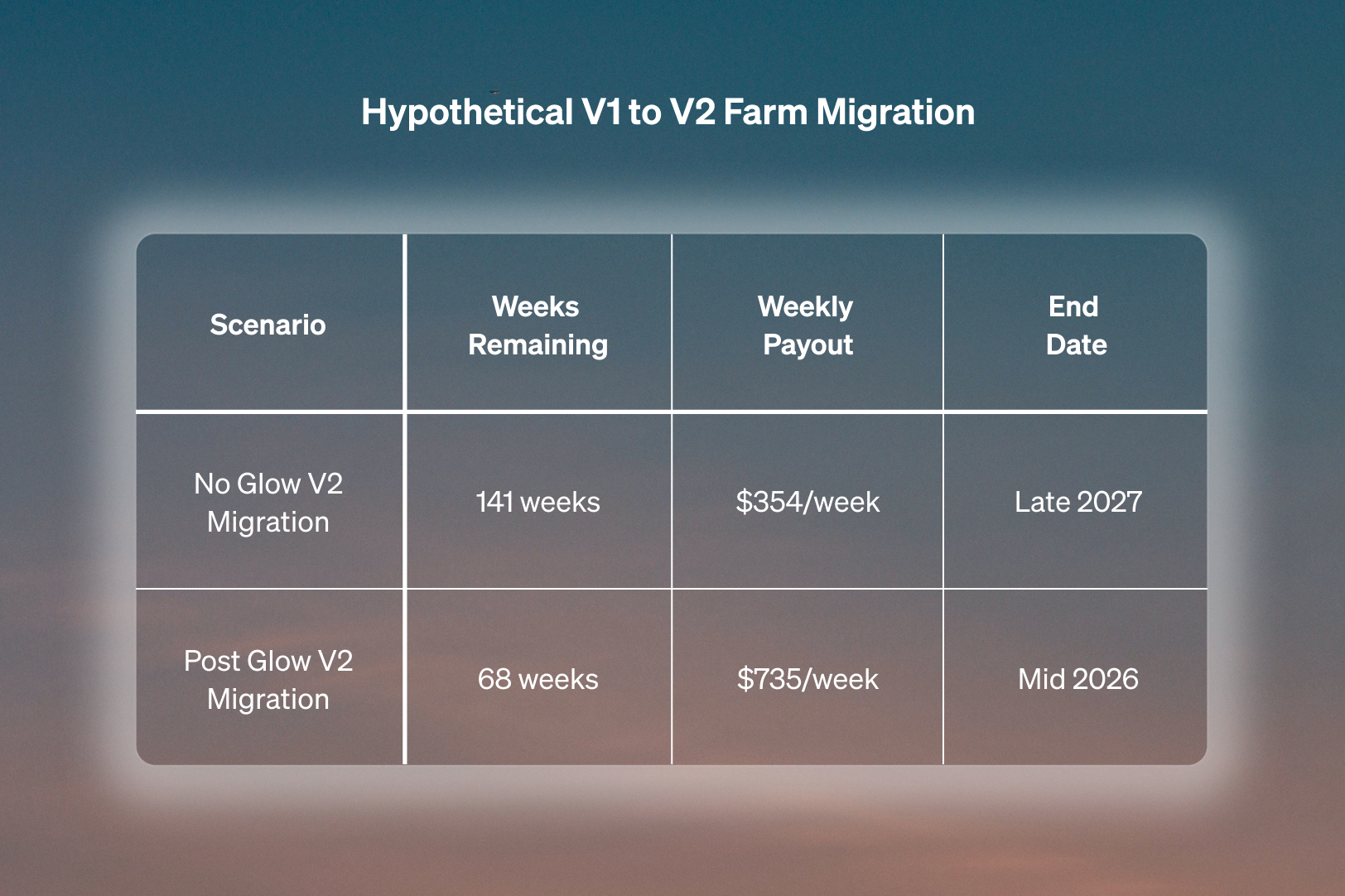
Assuming average competitive performance
The farm receives the same $50,000 total while completing deposit recovery 1.5 years sooner. This result generally holds true for all farms migrated from V1 to V2. Each farm can expect to earn back its protocol deposit 2.08x faster following V2 launch, earning roughly twice as much deposited capital per week compared to the V1 schedule. This acceleration reduces the opportunity cost of capital committed to protocol deposits and makes participation more capital efficient for every farm, regardless of when they joined or their performance tier.
Clean Grid Project Forfeitures and Leftovers
The migration tracked unallocated USDG from evicted farm deposits, initial USDG rewards liquidity, and rounding adjustments, ensuring V2 properly accounts for surplus USDG available to new farms versus funds committed to returning V1 deposits to migrated farms.
The rewards migration algorithm processed each active farm's protocol deposit history and subtracted the expected weekly returns from each week's total available USDG rewards pool. In V1, deposits were earned over 192 weeks, since the 208-week total schedule included a 16-week safety period where rewards accumulated but couldn't be withdrawn, leaving 192 weeks for actual deposit recovery. The weekly return amount was calculated as ceil(depositAmount / 192). Protocol deposits from evicted farms were not subtracted, since those farms were removed without completing their deposit recovery.
What remained after this accounting were the cgpLeftovers: unallocated USDG that included uncollected early liquidity rewards, forfeited deposits from evicted farms, and rounding differences between what gets subtracted (ceil) versus what farms receive (floor). These leftovers represent USDG available for new farms in V2 rather than committed to returning V1 deposits.
Migration Timeline
During V1 operation, farms continued earning on the 208-week schedule with all deposits and rewards tracked in the V1 system. At week 97, when V2 launched, the migration algorithm processed complete V1 history, calculated remaining weeks for each farm, and transitioned all farms to the new schedule.
Farms immediately began earning on the compressed schedule with weekly deposit recovery payouts approximately 2.08x higher than V1. Migration was fully automated, with each farm's on-chain V1 history automatically determining its V2 configuration, allowing farms to seamlessly continue recovering deposits on a faster timeline.
The full specification for the V1 to V2 rewards migration can be found here.